Teaching Isn't a Recipe
For 21 years, I taught science — usually chemistry. One lesson I learned quickly was that two classes are never exactly alike. Even when I taught the same course, the same standard, and the same lesson several times in one day, one class might understand it right away while another might struggle. A lesson that worked beautifully in one period could fall flat in the next.
Good teaching means noticing what is happening and making changes when students need them. Teachers hear the questions students ask and see the mistakes they make. They notice when an idea has clicked — and when it hasn’t. They can often tell from a student’s face that an explanation isn’t working and it’s time to try a different approach.
What works for one student or class may not work for another. One student may need a different example, another may need more time, and a third may need to see or do something instead of hearing another explanation. Knowing when to make those changes is part of teaching.
But Schools Also Need Consistency
Parents should be able to expect a high-quality education no matter who their child's teacher is. Schools need clear academic expectations and a good curriculum. They also need ways to see when students are falling behind and when they need additional help.
Consistent instruction can also help schools spot larger problems. If students across several classes are struggling with the same skill, that may point to a curriculum gap or a need for broader support rather than a problem in just one classroom.
Common expectations can also make it easier for teachers to work together. When students move between classes, teachers, or campuses, common academic expectations and a shared understanding of what students should learn can help keep instruction connected.
The Challenge Is Finding the Right Balance
Teachers work within the expectations, curriculum, and instructional systems their district sets. Those choices can help create shared expectations, but they can also limit how much a teacher can change when a particular class or student needs something different. Students and classes are not all the same, and a district cannot predict everything that will happen inside a classroom.
If too much emphasis is placed on making classrooms the same, teachers may be expected to teach the same way even when their students need something different. Evaluation of instruction can become more about demonstrating the use of particular strategies than whether the teacher has selected the best approach for those particular students. Following a process can start to matter more than whether it actually helps students learn.
This is not a new concern. The Organization for Economic Co-operation and Development (OECD), which studies education systems worldwide, has cautioned against making teaching expectations so specific that they dictate one particular way to teach. Teachers can use different approaches and still meet the same academic expectations.
We Hear a Lot About “Data” — Is It the Answer?
Schools and teachers should use data to make instructional decisions. Test results and other information can reveal patterns that are easy to miss. They may show that several classes are struggling with the same idea or that a group of students needs more help.
But numbers do not always explain why something is happening or identify the best way to address it. The teacher working with students is best positioned to connect the data to what is happening in the classroom, identify what may be causing the problem, and decide what to try next.
Data also has limits. A test score can be affected by things that have little to do with what a student actually knows that day. And numbers can sometimes end up being used to support instructional decisions without showing the full context of what was happening with the student. Data is useful, but it cannot replace the human side of teaching. The goal should always be to use all information to empower teachers to help students learn.
The Problem of Time
Effective instruction also depends on time. Good teaching isn't just what happens while a teacher stands in front of students. Teachers need time to plan lessons, prepare materials, review student work, consider what students are struggling with, and decide what to do next.
As a teacher at South San High School, I had one 45-minute planning period each day — in theory. But that time was rarely uninterrupted. Students stopped by with questions or problems, I had to locate lab equipment, technology failed, and meetings were sometimes scheduled. An entire planning period could disappear before I even sat down.
I rarely had enough time during the school day for the kind of thoughtful preparation, analysis, and decision-making that research shows can improve instruction. I did most of my planning, preparation, and lesson development in the evenings, on weekends, and during the summer. I rebuilt lessons, improved labs, and created hands-on materials not required by the curriculum but that I knew would help students learn.
My experience is not unusual. RAND, a nonprofit research organization that studies education and other public policy issues, found that teachers reported working an average of 53 hours a week, about 15 hours beyond the time they were paid to work, and recommended giving teachers more time during the school day for planning, grading, and working with colleagues.
“About one out of every four hours that teachers work per week is uncompensated.” — RAND Corporation, State of the American Teacher
And That Brings Us to Money
Creating more time for teachers to plan, prepare, and think carefully about instruction requires districts to make choices about staffing and funding. A district might hire additional teachers, reduce teaching loads, or build more planning time into the school day. Whether it can do those things depends not only on how much money is available, but also on how district leaders manage resources and set priorities.
When money is poorly managed or diverted to other priorities, teacher time is often one of the first things to go. That can mean less time to analyze student learning, think through what students need next, and make thoughtful instructional decisions. Decisions about one part of an instructional system can ripple through other parts. The graphic below shows how the different parts of an effective instructional system are connected and depend upon one another.
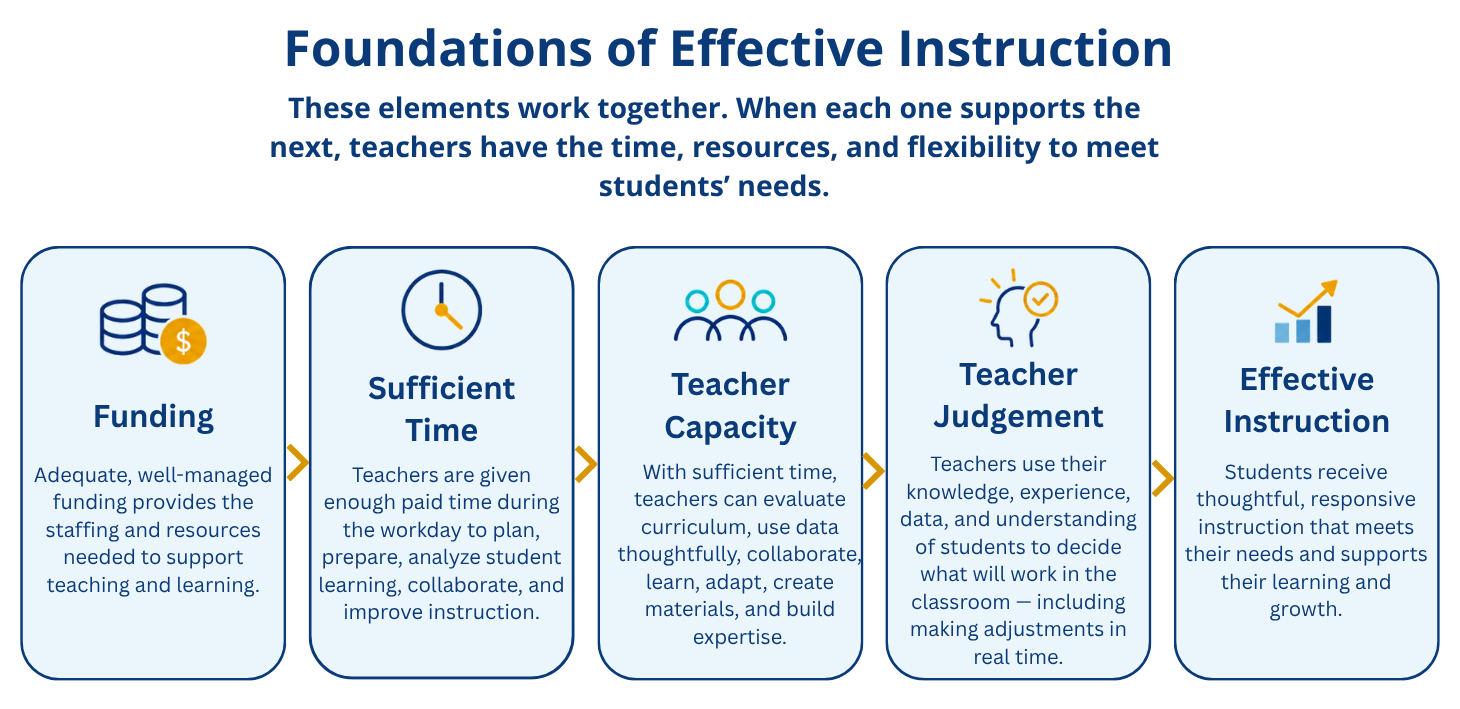
South San's Instructional System
I worked at South San High School for eight years. During that time, we always had curriculum, assessments, teacher collaboration, classroom evaluations, professional development, and other systems intended to support instruction. And there were signs that those systems were beginning to produce results. By 2024, South San High School’s accountability score had risen from 59 to 74 over four years, and other campuses in the district also showed signs of improvement.
Then, in February 2025, the Texas Education Agency (TEA) took over governance of the district by replacing the elected trustees with a Board of Managers and appointing a new superintendent. According to TEA's special investigation report, the district had a prolonged history of governance problems and weak financial controls.
Just weeks after TEA appointed Saul Hinojosa as superintendent, he proposed implementing NIET/TAP districtwide immediately, an instructional model created by businessman and philanthropist Lowell Milken. This model assumes that greater consistency, along with more district-directed support and oversight, will lead to better teaching and more student success. In practice, that also means more prescribed instructional practices, more classroom evaluation and monitoring, and more required documentation. On April 14, 2025, the TEA-appointed Board of Managers approved the proposal.
In addition to the new NIET/TAP requirements, the new superintendent and Board of Managers added district expectations for curriculum, planning, documentation, and monitoring. Instruction in South San classrooms is now shaped more by the NIET/TAP model and the district’s added expectations, and less by teacher judgment and professional expertise.
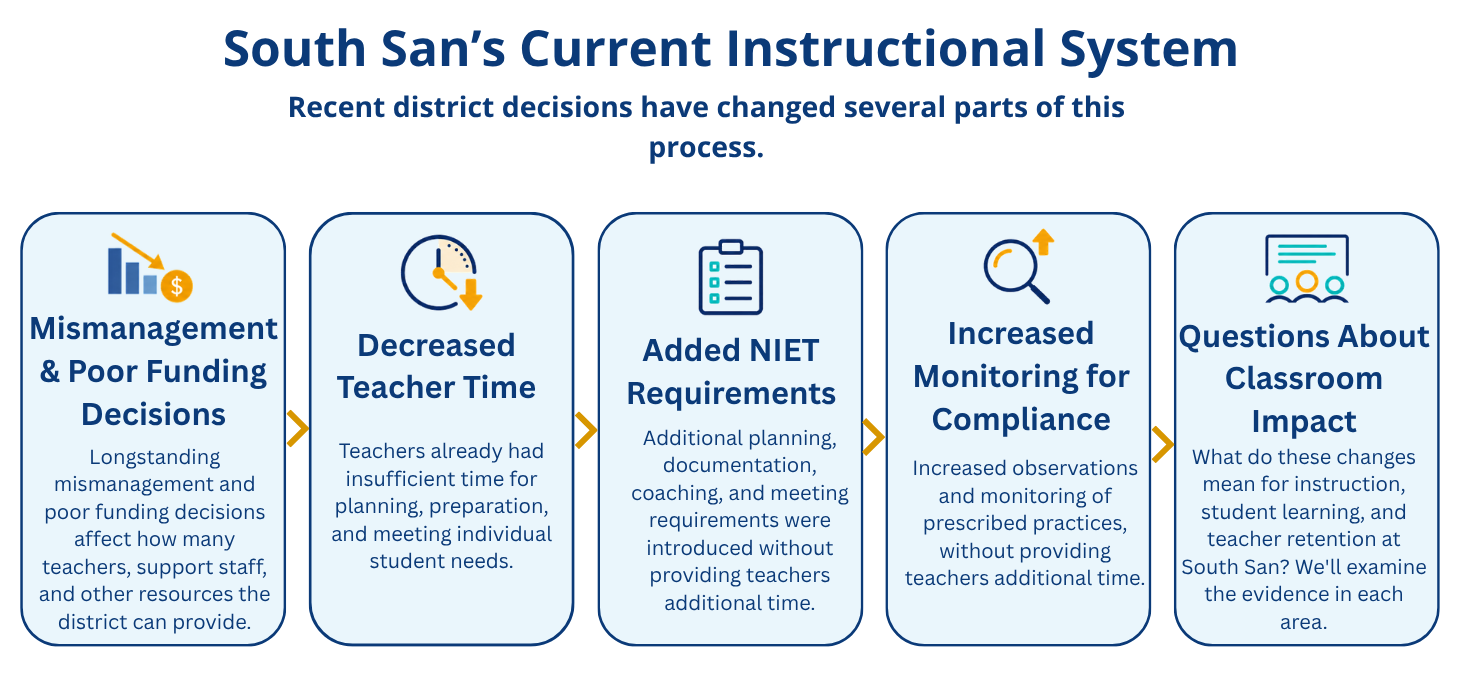
Effective instruction doesn't come simply from choosing the right curriculum, strategy, or system. A good instructional system must balance common expectations with the professional judgment teachers use every day — knowing when consistency helps and when students need something different.
In future articles, we’ll look more closely at the changes affecting South San classrooms. We’ll separate NIET/TAP requirements from the additional requirements South San added. We’ll also examine how those choices affect teacher time, classroom decisions, student learning, and teacher retention.
Coming Soon: Starting at the Source — Where Does South San’s Money Come From, Where Does It Go, and What Can It Actually Pay For? Next, we’ll look at South San’s history of financial mismanagement, how Texas funds public schools, what Proposition A is, and how money decisions affect teaching and learning.