If you haven’t read Part 1, start here.
In an effort to improve student performance, South San adopted NIET/TAP, a model that puts changing teacher practice at the center of its improvement strategy. Teachers are trained, coached, observed, and evaluated against prescribed instructional practices. But before asking whether NIET/TAP was the right solution, there is a more basic question:
Was ineffective teaching actually a significant problem at South San?
To answer that, we went back to the period before Superintendent Hinojosa arrived and before TEA appointed the new Board of Managers. We looked at what South San itself had already identified as its major needs and challenges, then followed the public record forward to see what changed, what evidence was presented, and when.
South San NIET/TAP Timeline
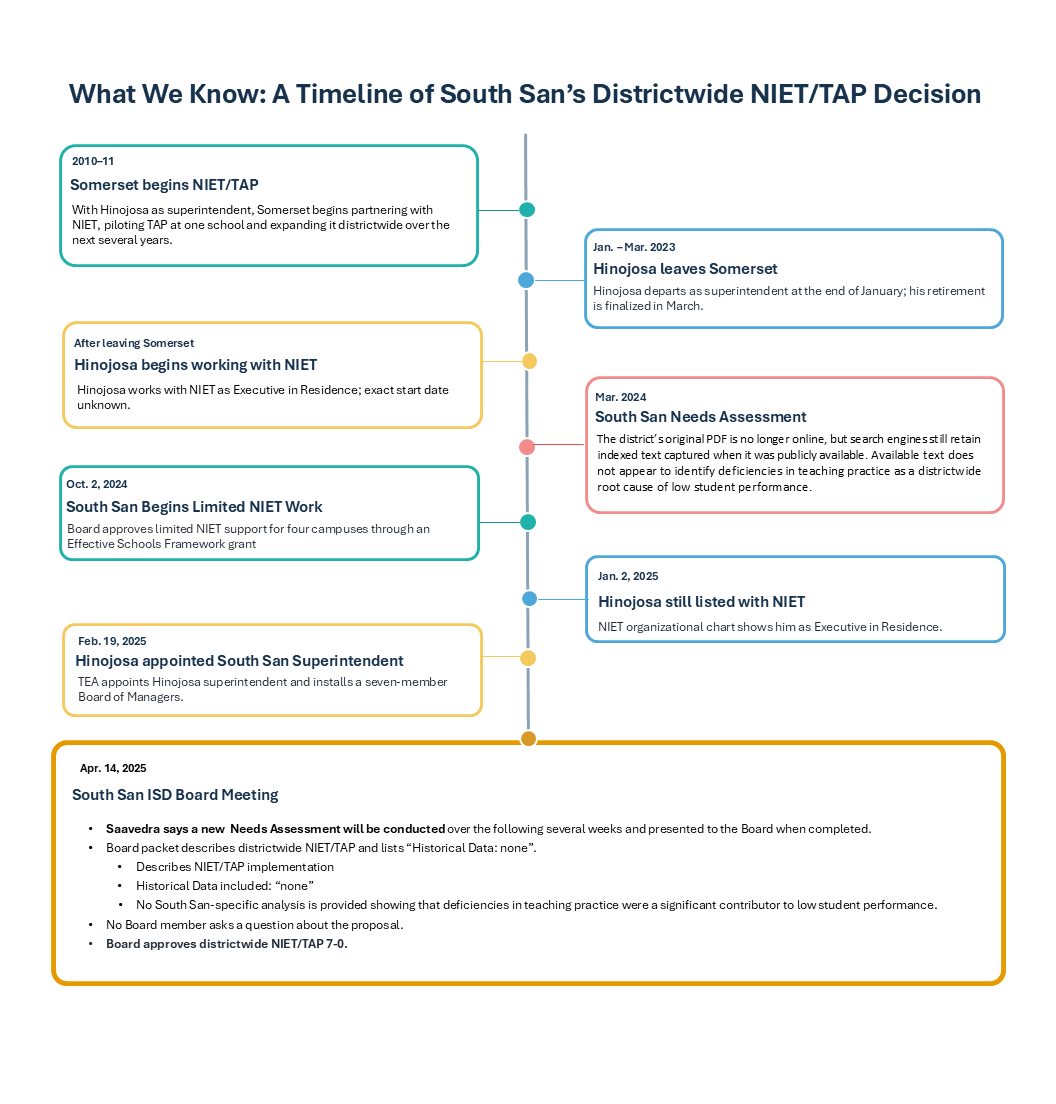
What the Timeline Shows So Far
We started by looking for South San’s March 2024 Comprehensive Needs Assessment. The district’s original PDF is no longer available at its former web address, but search engines still retain indexed text captured when the document was publicly available.
That text identifies teacher turnover as the formal staff-quality concern. It does not appear identify deficiencies in teaching practice as a districtwide root cause of low student performance. Other identified needs included learning loss, curriculum and intervention systems, data use, and related district processes.
Then came April 14, 2025. TEA Conservator Abe Saavedra told the Board that “over the next several weeks” he would conduct a new Needs Assessment with Hinojosa and district staff. He said the completed assessment would be presented to the Board and used to identify specific goals for the district. At that same meeting—before that assessment had been completed—Hinojosa recommended districtwide implementation of NIET/TAP, and the Board of Managers approved it 7–0.
What Had the Board Considered Before the Vote?
In an effort to find evidence that the Board had examined districtwide NIET/TAP and evaluated it as a solution before April 14, we reviewed the Board’s public meeting calendar and posted meeting records leading up to the vote. We found no public record showing earlier Board consideration of districtwide NIET/TAP.
It is important to note that South San had worked with NIET previously in a limited capacity. That earlier involvement, however, was substantially different from the districtwide NIET/TAP system proposed and implemented in 2025.
So then we looked at what happened at the April 14 meeting itself. Hinojosa described NIET/TAP and asked whether Board members had any questions. No Board member asked a question about the proposal. After a motion and second, the chair again invited discussion or questions. None followed, and the Board approved districtwide NIET/TAP 7–0.
What Was in the Board Packet?
The official Board record includes an eight-page attachment for the April 14 NIET/TAP agenda item. It includes the agenda summary and NIET’s Statement of Work for districtwide TAP support at 12 schools, totaling $252,500. Under “Historical Data,” the summary states “none.”
We found no South San-specific data showing how widespread problems with teaching were, no analysis connecting those problems to low student performance, and no root-cause analysis identifying teaching practice as a significant contributor to the district’s academic results.
So where was the evidence supporting such a significant districtwide restructuring of instruction?
So far, we’ve determined:
• The new Needs Assessment had not been completed when the Board voted.
• We found no public record of earlier Board consideration of districtwide NIET/TAP.
• No Board member asked a question when the proposal came up for approval.
• The materials provided before the meeting contained no South San-specific analysis showing that problems with teaching were a significant contributor to low student performance.
Four months later, the Board met for an August 25 workshop. Hinojosa and his team presented what was described as their “data analysis and root cause.”
Was this where the missing evidence would appear—and what did the district’s root-cause analysis actually show?
Continue to Part 3: Where Is the Root-Cause Analysis?