New to the series? Read [Part 1] and [Part 2].
In Part 2, we followed the public record through the April 14, 2025 vote to approve districtwide NIET/TAP. The timeline below follows what happened next.
What Happened After the April 14 Vote?
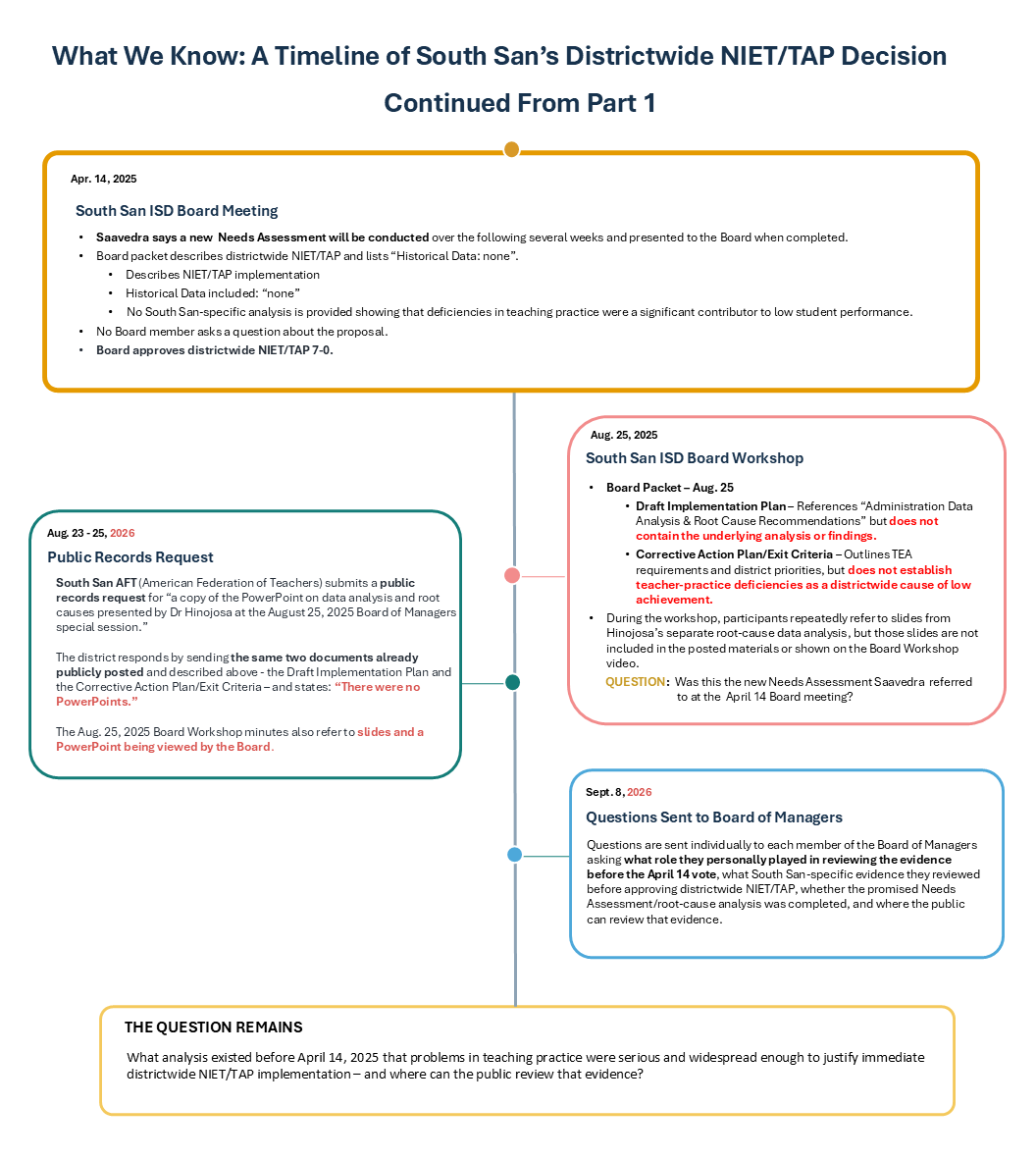
[View the complete South San NIET/TAP timeline.]
Recall that in [Part 2], we learned that TEA Conservator Abe Saavedra had promised a new Needs Assessment, which would be conducted over the following several weeks and presented to the Board. Yet districtwide NIET/TAP was approved that same night, before the new assessment had been completed. The public materials for that vote did not include South San-specific analysis showing that problems in teaching practice were a significant contributor to low student performance across the district.
Four months later, at the [August 25 workshop], Hinojosa and his team presented what was described as their “data analysis and root cause.” During the presentation, Hinojosa asked for a “PowerPoint presentation,” and participants repeatedly referred to and moved among slides while discussing the administration's analysis.
But the presentation itself is not shown in the public workshop video we reviewed. We can hear participants referring to and moving between slides, but the viewer never sees them. We also did not locate the presentation among the publicly posted workshop materials.
Nearly a year later, in late August 2026, South San AFT—the local affiliate of the American Federation of Teachers—submitted a public-records request for “a copy of the PowerPoint on Data Analysis and Root Causes presented by Dr. Hinojosa at the August 25, 2025 Board of Managers special session.”
The district responded by sending the same two documents already publicly posted for the workshop—the Draft Implementation Plan and Corrective Action Plan/Exit Criteria—and stated: “There were no PowerPoints.”
Why Does the Missing Presentation Matter?
Districtwide NIET/TAP had already been approved for four months. So why was the administration only now presenting its data analysis and root-cause work? One of the recommendations discussed was to “invest in teacher capacity.” The missing presentation could help show how the district moved from its data to that recommendation—and whether its analysis identified teacher-related factors as a significant contributor to low student performance.
Without the presentation, we cannot see what teacher-related evidence was shown, how strongly it supported the administration’s conclusions, or how those factors compared with other possible causes of low student performance.
The public record therefore leaves several questions unresolved. Why isn’t the presentation visible in the public workshop video? Why wasn’t it included with the posted workshop materials? And why, when South San AFT specifically requested the PowerPoint discussed during the meeting, did the district respond that there were no PowerPoints?
To see whether the Board members could provide answers, on September 8, 2026, we sent [questions] individually to each member asking what role they personally played in reviewing the evidence, what South San-specific evidence they reviewed before approving districtwide NIET/TAP, whether the promised Needs Assessment or root-cause analysis was completed, and where the public can review that evidence.
As of October 1, 2026, no responses had been received from any of the Board Managers. [Check here] to see whether any responses have been received since then.
Why the Evidence Matters
NIET/TAP was not a minor change. It involved additional costs, changed how teachers are trained, coached, observed, and evaluated, and shifted more instructional decision-making from individual teachers toward district-directed expectations and practices.
For a decision of that scale, the public should be able to review the underlying data and analysis—with personal or identifying information removed where necessary—so they can evaluate whether the evidence supports the district’s conclusions.
So WERE teachers really what South San needed to fix?
Based on the public record we have been able to review, we still cannot answer that question. The August presentation may contain information that would help, but we cannot evaluate evidence we cannot see. Until the underlying analysis is available for public review—or additional evidence is provided—we cannot independently determine whether the evidence supported making deficiencies in teaching practice such a significant focus of South San’s improvement strategy.
What Can You Do?
Ask district leaders. Contact the [Superintendent] and [Board of Managers] and ask whether the promised Needs Assessment was completed and where the Needs Assessment, root-cause analysis, and August 25 presentation can be reviewed.Request the records. If the documents are not publicly available, [submit a public-information request] to South San.Share what you find. If you receive a response or document that helps answer these questions, [contact South San Education Explained] so we can review it an
Coming Soon: The September 21 Board Meeting — Explained
A plain-language look at what the Board heard and decided, what the district’s presentations and data actually showed, and what questions remain.
Coming Soon: What Are They Really Saying?
Learn how to unpack district claims, data, and presentations—what is actually being said, what evidence supports it, what may be missing, and what conclusions the evidence does or does not support.